


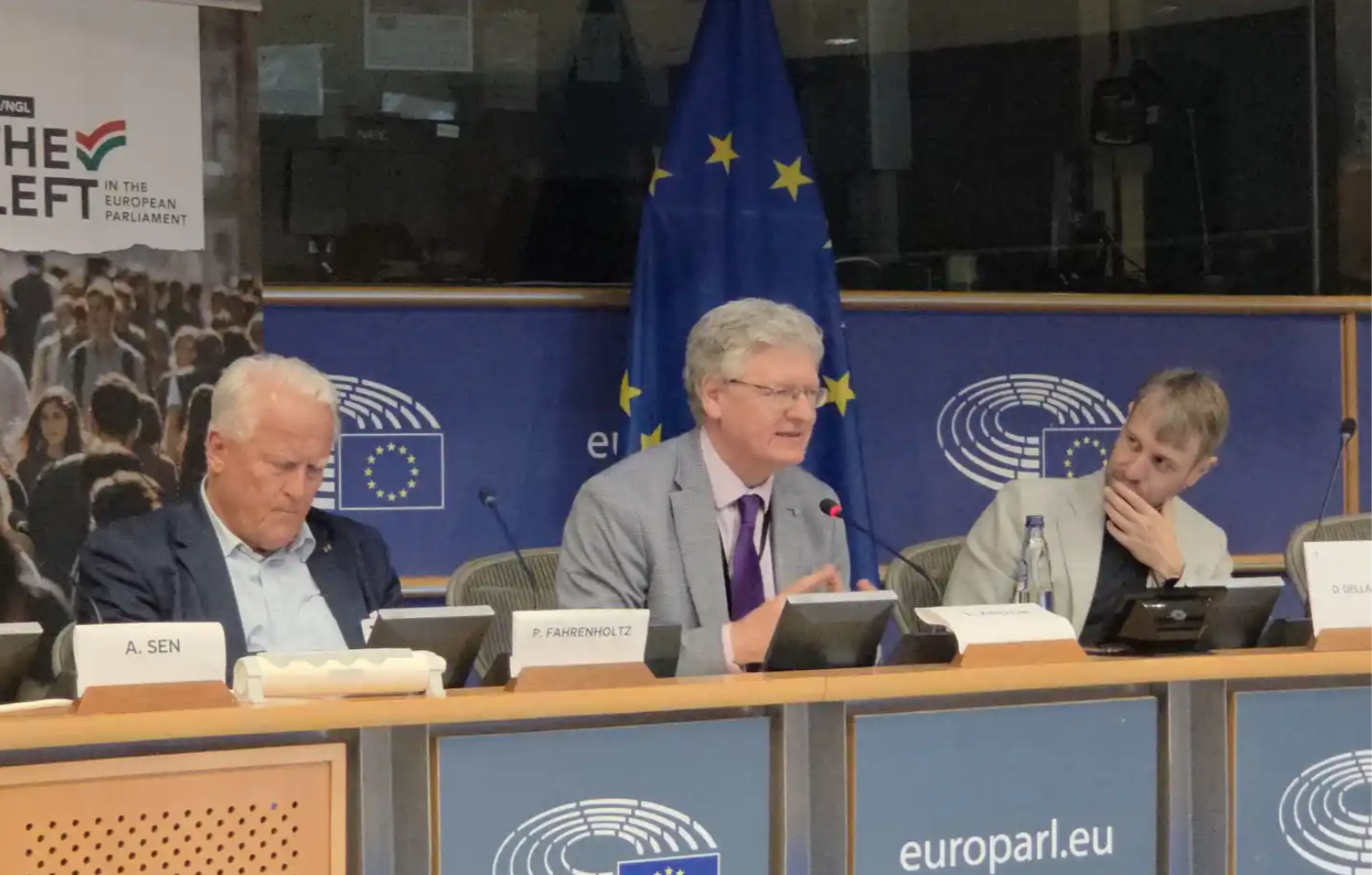
BRUSSELS | 30 September 2026 — The European Parliament in Brussels became the setting for a significant cross-regional dialogue on South Asia–Europe relations, peace, trade and economic cooperation, bringing together political leaders, diplomats, business representatives and institutional voices from across Europe and Asia.
Titled “Europe and South Asia: Partners for Peace and Prosperity,”the gathering was held at the European Parliament on 30 September and was spearheaded by MEP Ondřej Dostál, the Czech lawyer and politician elected to the European Parliament in 2024. Dostál currently serves as a non-attached Member of the European Parliament and is a member of its delegation for relations with Southeast Asia and ASEAN.
The United Diplomatic Council (UDC participated with a delegation, adding an international diplomatic and business perspective to the discussions.
The meeting brought together participants and representatives from India, Pakistan, Bangladesh, China, France, Mongolia and Myanmar, alongside business and institutional representatives from Belgium, Czechia, Poland, Sri Lanka and Malaysia, as well as partner countries including Sudan and Ethiopia. Ambassadors, a former Foreign Minister, a former Vice-President of the European Union and senior diplomatic, medical, academic and business personalities were also present.
At the heart of the discussion was a simple but increasingly important proposition: economic engagement can create channels for dialogue even where political differences remain unresolved.
Trade, connectivity, investment, technology, education and business-to-business relationships were discussed not merely as economic subjects, but as practical instruments for keeping countries engaged with one another.
For UDC, the meeting also marked the beginning of a wider engagement in Europe and South Asia.
Dr. Asif Iqbal, President of the United Diplomatic Council, emphasised the importance of creating platforms where governments, diplomats and the private sector can meet beyond traditional diplomatic channels.
“Peace cannot be built only through political dialogue. Economic relationships create interdependence, regular contact and reasons for countries to keep talking. This gathering is the beginning of a much wider conversation.”
MEP Ondřej Dostál, who hosted and spearheaded the parliamentary discussion, underlined the value of bringing different countries and perspectives into the same room.
“Europe and South Asia have much more in common than is often recognised. Dialogue should not disappear because there are differences. Parliament, diplomacy, business and civil society all have a role in keeping that dialogue open.”
The gathering also benefited from the presence of former German Ambassador Peter, whose diplomatic experience added a European perspective to the discussion. A senior neurosurgeon participating in the programme also highlighted the importance of people-to-people engagement, noting that international cooperation increasingly extends beyond governments into science, healthcare, research and professional networks.
What made the Brussels meeting particularly relevant was what happened around the formal programme. Several bilateral and side discussions opened possibilities for follow-up cooperation, including conversations around economic partnerships, institutional linkages and the revival of relationships that had not received sufficient attention in recent years.
For UDC, this is intended to be the first of a series of engagements, rather than a one-off conference. The objective is to carry the conversation forward through further parliamentary, diplomatic and business-level interactions.
The Brussels meeting demonstrated that diplomacy does not always begin with a treaty or an official negotiation. Sometimes it begins with people sitting around the same table — listening, questioning, disagreeing and discovering areas where cooperation remains possible.
The next phase will be about converting those conversations into structured partnerships, institutional exchanges and economic engagement.





Leave a Reply